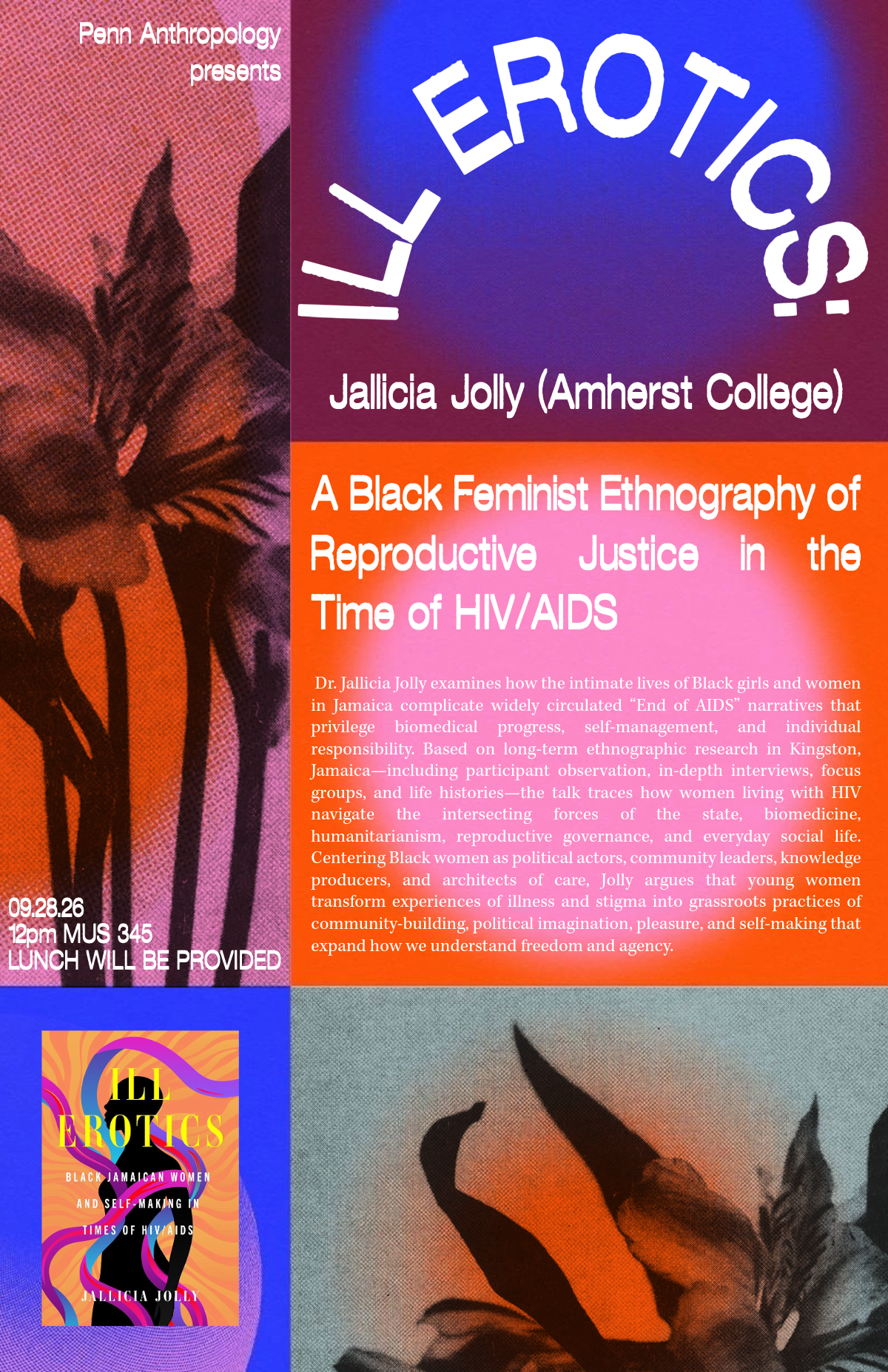
Ill Erotics: A Black Feminist Ethnography of Reproductive Justice in the Time of HIV/AIDS
Penn Anthropology Colloquium
MUS 345
ADA Accessible

About the talk
Dr. Jallicia Jolly examines how the intimate lives of Black girls and women in Jamaica complicate widely circulated "End of AIDS" narratives that privilege biomedical progress, self-management, and individual responsibility. Based on long-term ethnographic research in Kingston, Jamaica--including participant observation, in-depth interviews, focus groups, and life histories--the talk traces how women living with HIV navigate the intersecting forces of the state, biomedicine, humanitarianism, reproductive governance, and everyday social life. Centering Black women as political actors, community leaders, knowledge producers, and architects of care, Jolly argues that young women transform experiences of illness and stigma into grassroots practices of community-building, political imagination, pleasure, and self-making that expand how we understand freedom and agency.
Speaker Bio
Dr. Jallicia Jolly is an internationally recognized writer, speaker, and reproductive justice researcher who is an Assistant Professor in American Studies and Black Studies at Amherst College. During her sabbatical/research leave for 2025-2026, Dr. Jolly was a Visiting Scholar at Princeton University's Center on Transnational Policing and the Effron Center for the Study of America. Dr. Jolly researches and teaches on Black women’s health, grassroots activism, and reproductive justice; the transnational politics of gender, structural racism, sexuality, class, and health; intersectionality and HIV/AIDS in the U.S. and Caribbean; Black feminist health science, Black motherhood, and birth justice. Dr. Jolly’s first book manuscript, Ill Erotics: Black Jamaican Women and Self-Making in the Time of HIV/AIDS (University of California Press), is officially available for pre-order and will be published on November 24, 2026, as part of UC Press's Reproductive Justice Series! Ill Erotics is an ethnography of the reproductive justice organizing of young Black Jamaican women living and loving with HIV that chronicles their everyday confrontations with illness, reproductive violence, and inequality in neocolonial Jamaica. A 2025 National Academy of Sciences U.S. Kavli Fellow, Dr. Jolly is the founder and director of the Black Feminist Reproductive Justice, Equity, and HIV/AIDS Activism (BREHA) Collective—an interdisciplinary, medical humanities lab that bridges research, advocacy, student collaborations, and high-impact learning experiences on the health and movement-building of Afro-diasporic girls, women, and gender diverse people.
Dr. Jolly connects her research to tailored community interventions that advance equity, systemic change & community-building within and beyond U.S. borders. Bridging the divides between academia and communities as well as theoretical and practical knowledge, Dr. Jolly works within racial justice and reproductive health equity organizations such as Women of Color Health Equity Coalition and Birth Equity and Justice Massachusetts (BEJMA). For five years, Dr. Jolly served as Co-Chair of Birth Equity and Justice Massachusetts (BEJMA), a multisectoral reproductive justice group that brings together clinicians, researchers, community organizations, advocates, legislators, and stakeholders to implement evidence-based interventions to improve outcomes for Black birthing people and advance equity in maternal health policy in the Commonwealth. She foregrounded excluded voices and perspectives to collaboratively combat structural racism and medical violence in and beyond the reproductive health care system. Ultimately, Dr. Jolly commits to elevating the health/medical humanities by harnessing the potential of reproductive justice theory and practice to develop and implement interventions that inspire institution change and eliminate racial, gender, and class-based inequities in health in the Americas and the broader African diaspora.
Graduating from the University from Michigan in summer 2020, Dr. Jolly holds a doctorate and master's in American Culture, and certificates in Women’s & Gender Studies, Afroamerican and African Studies, and Science, Technology & Society as well as in Center for Research on Learning and Teaching and Diversity & Equity. Dr. Jolly conducted her doctoral research in Kingston, Jamaica, completing over 18 months of ethnographic work across multiple sites including local communities, HIV clinics, nonprofit and governmental organizations, medical institutions, and global health agencies. She uses ethnographic methods of "vulnerable observation," participant observation, and semi-structured interviews, as well as qualitative research methods including oral history, cultural analyses, focus groups, surveys, and media content analyses. Rooted in transnational Black feminist and reproductive justice frameworks, her scholarship is invested in expanding the geographic and thematic scope of studies of Black women's health, activism, and political leadership. She remains remain attentive to the ethics and politics of documenting inequality, illness, and violence, and is deeply committed to liberatory practices for doing culturally-relevant, ethically and politically invested work that creates a more just present and future.
A public scholar committed to research-informed action, Dr. Jolly has written for various media outlets such as Forbes, The Conversation, The Washington Post/The Lily, USA Today, Ms. Magazine, Huffington Post, Rewire News, The Boston Globe, Nursing Clio, Black Youth Project, National Center for Institutional Diversity’s Spark Magazine, and the University of Michigan’s Rackham Graduate School Blog.
Dr. Jolly’s scholarship has been awarded recognition and supported by grants/fellowships such as The Robert Wood Johnson Foundation, The Ford Foundation, the U.S. Student Fulbright Program, Andrew Mellon Foundation, Brown University's Pembroke Center for Teaching and Research on Women, the American Association of University Women, Yale University’s Center for Interdisciplinary Research on AIDS (CIRA) and Sarah Petit Doctoral Fellowship in Queer Studies, Blue Cross Blue Shield of Massachusetts Foundation, Social Science Research Council, Institute for Citizens and Scholars, the Edward Bouchet Graduate Honor Society, the National Women's Studies Association, and the University of Michigan's Institute for the Humanities and the the Institute for Research on Women & Gender. She received her Bachelor’s degree in Women's, Gender, and Sexuality Studies with a minor in Africana Studies and Spanish, receiving high honors from Williams College. A 2012 Mellon Mays Undergraduate Fellow, she was also a recipient of the Gaius C. Bolin 1889 Prize in Africana Studies, the Nancy McIntire Prize in Women’s, Gender, and Sexuality Studies, and the Gilman International Fellowship. Dr. Jolly's work has been published in American Quarterly, The Lancet, Feminist Anthropology, Souls, Meridians, Gender, Place, and Culture, and American Anthropologist.
As a community-engaged researcher and an equity practitioner, she dedicates her work to improving the well-being of marginalized communities while elevating the organizing and interests of women in the African diaspora using human rights and reproductive justice frameworks. Dr. Jolly's scholarship and community-engaged work foregrounds the interrelationship between lived experience, pedagogy, and political engagement, and is invested in the values of sustained reflexivity, an ethics of caring, and reciprocity.